
The Ladder of Reading & Writing© (2012/2026)
Introduction to the Update:
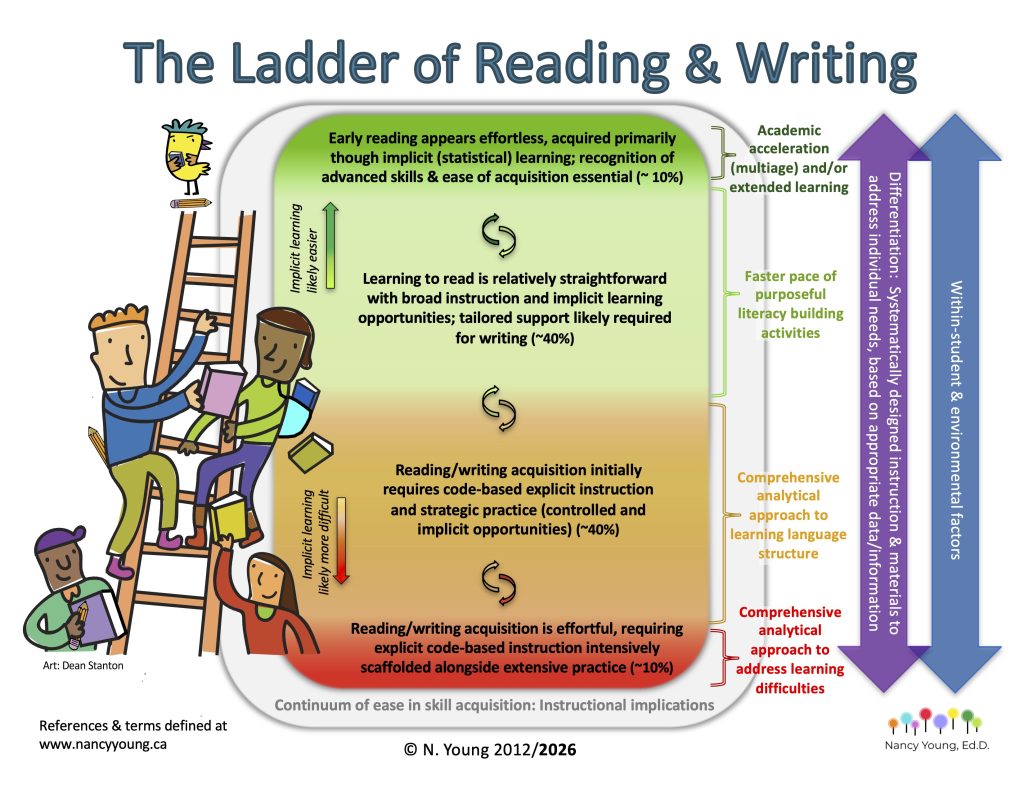
This update represents my continued efforts to build understanding of the wide range of ease in literacy acquisition. A needs-based approach is central to the programming implications represented by the terms and features on my Ladder of Reading & Writing. WHO needs WHAT? Can we justify WHY certain instruction and materials are appropriate?
From its very first iteration, my Ladder of Reading & Writing has represented the continuum of ease in skill acquisition. Over the years I’ve made changes not only to expand upon the research-informed messages, both new research and previous research, but to clarify terminology and try to prevent misconstruing of the features and words.
Greater visibility for “implicit learning” was the main impetus for the 2026 update. When I added “implicit” next to the light green on the continuum back in 2023, my hope was that this term would become integral to conversations about, and systematic design of, reading instruction. Implicit learning was addressed in the book I co-edited with Jan Hasbrouck, Climbing the Ladder of Reading & Writing: Meeting the Needs of ALL Learners (2024). Yet, despite all the attention given to the “science of reading movement” since 2023, I have been dismayed at the lack of attention to (and, sadly, even resistance to) this aspect of learning. I found myself regularly wishing that I had given “implicit learning” greater visibility in my 2023 update. The 2026 update does so!
Whilst implicit learning” was the catalyst, I reexamined every single word and feature during the 2026 update process. I thought deeply about how I might even better translate the science and prevent misconstruing during this time of rapid changes and overcorrections that seem to be happening in the field. My observations (and worries that many children are still not being taught based on need) prompted me to make changes to some words in my infographic, within and beside the coloured continuum and in the purple arrow, so to delineate differing needs with greater clarity. The changed wording is explained in the overview below. Note that I have provided a lengthier description of the wording related to dark green area of the coloured continuum due to the current lack of attention to, inappropriate instruction and materials for, and misunderstandings of students who read earlier and more easily than typical.
I’m immensely grateful to those of my colleagues who provided me with a sounding board during the many months of my 2026 update process. Their names are listed at the end of this overview.
Update Caveats:
- My Ladder of Reading & Writing offers a “big picture”, representing my understanding of the research and shedding light on WHO needs WHAT and WHY
- Science is not static; both new research and insights into older research continue to generate understandings of ways to improve instruction based on need
- Interpretation and application of science recognizes that uncertainties and nuances exist
- The advocacy of understandings based on science recognizes gaps in the current research
Update Summary: The Features and Terminology of The Ladder of Reading & Writing (2026)
What follows is an explanation of the features and terms I have included in my 2026 update. To keep this from being overly long, I have kept citations within this blog post to a minimum. Please refer to the following for additional supporting research and related information:
- Document with definition of terms HERE
- Document listing references underpinning the extensive research and many reports etc. supporting the information shared within my Ladder of Reading & Writing HERE
- Document specific to “continuous distribution” HERE
- Cited chapters within the BOOK I co-edited with Dr. Jan Hasbrouck, Climbing the Ladder of Reading & Writing
- Links to additional supporting research listed under the Resources in the menu of my website
The Title:
The Ladder of Reading & Writing
In the title, the word “writing” represents two components (Fletcher et al., 2019):
- Transcription (mechanics, such as letter formation and spelling)
- Generation (composition of various forms of text)
For this reason, I have not separated out spelling within the coloured areas of the continuum. Needs-based instruction in writing (transcription and/or generation) will be part of systematically designed literacy instruction.
The Ladder Itself:
Dean Stanton’s Art of “Children” Climbing a Ladder
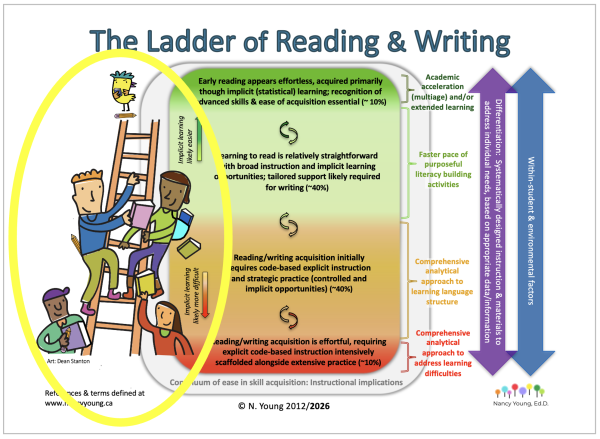
From the first iteration of my Ladder of Reading & Writing, I have likened the journey of learning to read as climbing the rungs of a ladder. Some children leap up the rungs, whilst other children go very slowly. The smiling “children” remind us that the journey should be as joyful as possible, whether is easy or difficult. Books and the pencils make it clear that climbing up the Ladder includes both reading and writing. Be aware that, due to the reciprocity of skill development, progress up each rung is not necessarily linear. For example, attention to the phonemes in words may help initial reading acquisition but reading itself builds phonemic awareness (Hoover & Tunmer, 2020).
Continuum Grey Border:
Words in the grey area below the continuum:
“Continuum of ease in skill acquisition: Instructional implications” The reading science indicates that learning to read entails repurposing brain wiring (Dehaene, 2011). However, the research also indicates that this repurposing process will be far easier for some than for others as a result of genetic and environmental interplay (Boada et al., 2002; Olson et al., 2014; Pennington et al., 2015; Christopher et al., 2015; Elliott, 2020). The words “Continuum of ease in skill acquisition” point out that the coloured areas of the continuum represent that range of ease, sometimes described as the “continuous distribution” or “normal distribution”. (The colours do not represent rungs children will go up; those are depicted in the Ladder itself, to the left of the coloured continuum.)
The Coloured Continuum:
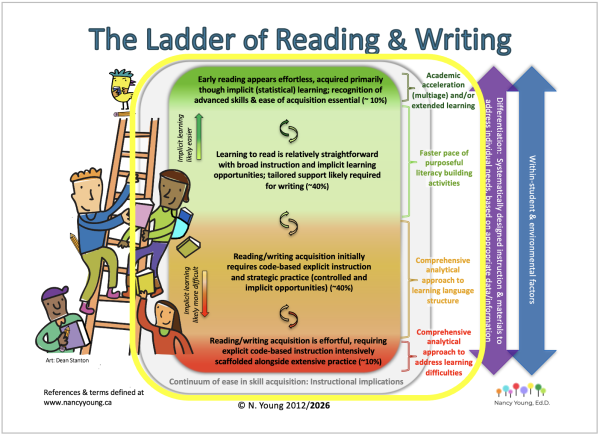
The red area of the continuum
“Reading/writing acquisition is effortful, requiring explicit code-based instruction intensively scaffolded alongside extensive practice”
As represented by the red area of the continuum, learning to read and write is very difficult for some learners. This necessitates systematically designed instruction that is intensively scaffolded (broken into small supported steps), taught in as a slow a pace as needed. Code-based acknowledges that written languages are based a code, and that foundational instruction includes the teaching of decoding skills. Substantial supported practice encompasses extensive practice of specific concepts that have been explicitly taught, including practicing of text aligned to lessons (many repetitions often being needed).
For learners represented by the red area of the coloured continuum, some will need more scaffolding and practice than others. Some will need intense instruction on phonemic awareness, whilst others will have no difficulty with phonemic awareness but need countless repetitions to master a spelling concept and/or support with comprehension. This means that differentiation will be necessary as we provide more (or less) instruction and support.
Although implicit learning is likely to be more difficult most for learners represented by the red area of the continuum, when a student cannot yet read independently it is important to provide opportunities that offer exposure to patterns of spoken and written language (such as adults reading aloud or a student using assistive technology). This enables statistical learning opportunities as well as the building of background knowledge
As there are several types of learning difficulties that can affect learning to read and write, no specific issues are listed in the red area. These are addressed within my explanation of the Blue Arrow below.
Words to the right of the red area of the continuum
“Comprehensive analytical approach to address learning difficulties”
To the right of the red area of the continuum, additional words relate to the systematic design of programming for learners represented by the red area. Instruction is likely to be comprehensive (multicomponent) and analytical (metacognitive). Given that these children do not respond successfully to the general instruction that supports the initial and steady development of foundational skills for other children of their age, they will require an approach addressing their learning difficulties (Fletcher et al., 2019). Examples:
- Students with dyslexia require systematically designed instruction to address their word-level reading difficulty (Hasbrouck, 2024).
- Students with a specific reading comprehension disability (SCRD) may have adequate word-reading skills but require systematically designed instruction for the building of vocabulary, background knowledge and comprehension (Clemens & O’Donnell, 2024).
- Students with an intellectual ability may require books adapted for their specific need, such as pictures and objects to support engagement and vocabulary development (Stewart et al., 2024).
Orange area of the continuum
“Reading/writing acquisition initially requires code-based explicit instruction and strategic practice (controlled and implicit opportunities)”
Systematically designed instruction for children represented by the orange area of the continuum recognizes the importance of code-based explicit instruction, but my inclusion of the word initially in this area of the continuum points out that it is not possible, nor is it necessary (nor is there enough time!), to explicitly teach every concept. Explicit instruction for these students is designed to set them up to transition to implicit learning. We must be discerning as we plan to ensure learners receive needs-based instruction as well as implicit opportunities, so to move up the Ladder as quickly as possible. Although the instruction for learners represented by the orange area of coloured continuum may look to have some general similarities in design as that for learners in the red area, concepts explicitly taught will have less scaffolding and the pace of instruction will be faster.
Strategic practice encompasses targeting newly learned skills through controlled practice opportunities, but strategic practice also entails implicit learning opportunities that enable ongoing exposure to many forms of spoken and written language, by various means, to build awareness of statistical patterns within. (Implicit learning is expanded upon later in this overview.) Within the orange area of the continuum, there will still be a range of needs. Some learners will move to self-teaching (Share, 1995) with fewer steps and practice than others. Differentiation will thus be necessary as we provide more (or less) instruction and support during the jumpstarting process.
Words to the right of the Orange area of the continuum
“Comprehensive analytical approach to learning language structure”
The words the right of the orange area of the continuum further pertain to the instructional needs of learners in the orange area of the continuum. Comprehensive makes clear instruction will not just focus on phonics but will integrate multiple components of language structure (including morphology, semantics, and syntax). Comprehensive also includes knowledge building. Analytical reflects the need for instruction that encourages students to be metacognitive during the learning process (Hoover & Tunmer, 2020).
Light Green area of the continuum
“Learning to read is relatively straightforward with broad instruction and implicit learning opportunities; tailored support likely required for writing”
Broad instruction for children learning to read more easily recognizes that these children learn at a faster pace than their age-similar peers represented by the orange area and (especially) the red area. Less needs to be directly taught, and less scaffolding needed, to ignite the climb up the Ladder. These children will grasp the alphabetic principal quickly and fewer sound-symbol correspondences will need to be taught before “self-teaching” begins (see Share, 1995).
For children represented by the light green area of the continuum, the systematic design of instruction and selection of related materials recognizes that “explicitness occurs on a continuum and can take a variety of forms” (Fletcher et al., 2019, p. 100). An example would be word sorting (Templeton & Morris, 2000), where explicit instruction might be provided by the teacher to demonstrate how to perform the activity and explain the task requirements, and then students would then engage in this activity with another student as they completed the task requirements. On subsequent days, students would engage in word sorting with only a brief explanation by the teacher and slight adjustment of task requirements. Other “hands on” peer interaction or discovery activities could also enable skill acquisition, task requirements and any essential instruction similarly provided by the teacher ahead. Implicit learning opportunities would be integral to the systematic design of instruction and materials, including lots of exposure to text (computer technology possibly used to assist in various ways as needed) and opportunities to hear and see spoken and written language.
The words tailored support are very intentionally used in recognition that learners represented by the light green area of the continuum are likely to need systematically designed writing instruction (given that learning to write is generally harder than learning to read) yet are likely to progress more quickly as compared to their peers represented by the in the orange area and (especially) the red area.
Words to the right of the Light Green area of the continuum
“Faster pace of purposeful literacy building activities”
For children who learn to read and write more easily, judicious selection of learning activities will be necessary. The goal is to learn to read, not to spend time being explicitly taught unnecessary concepts or information. The systematic design of instruction will carefully consider the purpose and avoid over-teaching, allowing for as rapid a pace of skill development as possible through both explicit teaching and implicit learning opportunities. Needs-based instruction for these children recognizes that they should not be sitting through foundational reading instruction designed for those for whom learning to read is more effortful, and that too much code-focused instruction may result in delayed learning (Connor et al., 2004). According to Connor et al.,
“[I]t is evident that at the level of the individual child, instructional activities and patterns that are considered high quality for one child may be considered poor quality for another.”
(2004, p. 329-30)
Purposeful learning also recognizes that systematic design of programming for children represented by the light green area of the continuum will include increasing amounts of time in child-led activities and less time in teacher-led instruction. (See Connor, 2014.)
Dark Green area of the continuum
“Early reading appears effortless, acquired primarily though implicit (statistical) learning; recognition of advanced skills & ease of acquisition essential”
Students represented by the dark green area of the continuum learn to read easily and early. Some will be reading two, three or even four grade-levels ahead in kindergarten. Their early skill development appears effortless as they “get the game” (Hoover, 2025) without the explicit instruction needed by other children of the same age. Although scientific studies have focused far more on on children who struggle than early advanced readers, research indicates children with high reading ability have a greater ability to acquire skills through implicit learning, to more easily extract the statistical patterns in spoken and written text. (See Arcuili, 2012.)
Learning early and with greater ease than typical necessitates learning opportunities that recognize already advanced skills. Many educators erroneously that students with advanced academic abilities will be fine without attention to their individual learning needs, but this belief is not supported by research. (See NAGC, n.d.) A lack of appropriate learning opportunities for advanced students may not only result in decline of skills but result in these very capable students becoming less motivated to learn. Appropriate learning opportunities must encompass not just advanced instruction but time during the school day for early advanced readers to read above-grade-level text and books based on their personal interests.
Any writing instruction (transcription and/or generation) provided for student represented by the dark green area of the continuum must consider the above-grade-level abilities of these students, including their ease of acquisition and likelihood that many will have an above-average intellectual ability (Slade, 2022). The systematic design of spelling instruction for these students must include recognition of advanced skills in reading and ease of acquisition, including their greater ability to learn concepts implicitly through exposure to words (thus the importance of lots of reading); a word study approach that addresses morphology and allows for discovery of the why of spelling (Treiman, R., 2018) can offer the intellectual challenge and high-level thinking these learners need. Any generative writing (composition) instruction should reflect the advanced abilities of these students and allow for various ways of creative writing. A caution that some early advanced readers may demonstrate asynchronous writing skills, meaning they will not have developed the fine-motor skills needed for letter formation despite reading three grade levels ahead. A flexible and understanding approach to any teaching of handwriting is crucial, including an engaging and creative process systematically designed to respect their advanced reading ability and intellect.
Words to the right of the Dark Green area of the continuum
“Academic acceleration (multiage) and/or extended learning”
Although not all students represented by the dark green area of the continuum will have been (or will be) identified as gifted, many of the children in this group are likely have above-average intellect (Slade, 2022). Lack of the opportunity to progress is not only a lost opportunity for them (and society) but will leave them at risk of becoming bored, discouraged and disengaged in their learning. For children who are advanced in academic skills, the first consideration in the provision of needs-based instruction should be acceleration.
Academic acceleration (multiage): Formal acceleration carefully considers the readiness of a child to learn advanced material within a multiage setting. Decades of research supports formal academic acceleration for students who have advanced abilities; although some educators and caregivers may worry about the negative social-emotional effects, the research has long indicated that for, the majority of students, this is not an issue. (See Colangelo et al., 2004 and VanTassel-Baska, 2026.) Examples for the early primary grades include:
- Early entrance to Kindergarten
- Skipping grade(s)
- Subject-area acceleration (studying one academic subject with students in a higher grade)
Less formal acceleration can be provided with a form of differentiation based on multiage grouping, collaboratively organized groupings based on skill, not age, by teachers of two or more grades. If multiage grouping is not possible for one reason or another, same-age grouping across a single grade can provide children of the same ability to learn with peers of similar ability. This would entail teachers of the same grade all collaborating to form skill-based groups. Grouping of students within a single classroom is also possible, within-grade or across-grade (multiage) grouping is likely to be more effective and more enjoyable for students and easier for their teachers. (One reasons is that it enables teachers to hone their own teaching skills to better serve students with certain needs.)
NOTE: Acceleration for students represented by the dark green area of the continuum does not mean explicitly teaching at a faster pace all the concepts some of their peers may need to learn (such as grapheme-phoneme correspondences or aspects of syntax). Such over-teaching would not only delay progress (Connor, 2014) but inhibit opportunities to learn what these students need (opportunity cost). Programming for students represented by the dark green area of the continuum must reflect that many of the components of spoken and written language will be picked up unconsciously (and likely not in the order taught in schools), and consider judiciously what needs to be learned and in what form it may best be mastered. Examples of appropriate acceleration for these students would include programming that incorporates advanced literature and advanced thinking modules. (See The College of William & Mary, 2013.)
Extended learning: For students represented by the dark green area of the continuum who are not accelerated for one reason or more, the provision of extended learning activities should be considered. The provision of complex activities and materials that enable learning to continue to progress through extended learning could be described as enrichment, but recognize that it is a deeper form of enrichment that enables growth for advanced students, with activities and expectations likely too complex for many of their peers. Extended learning programming could include self-directed learning (e.g., guided inquiry delving into an interest area).
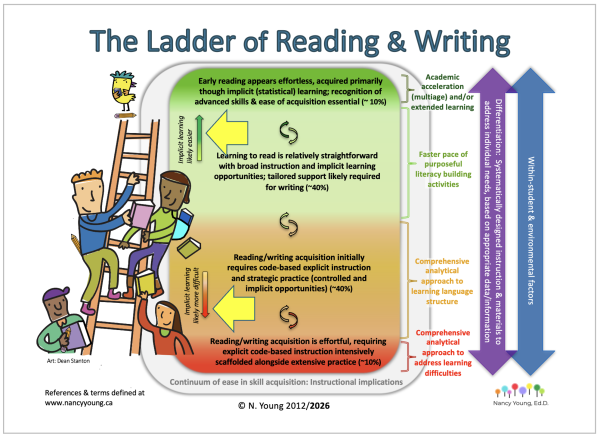
Words and arrows going down the left side of the continuum
“Implicit learning likely easier” (arrow with light and dark green transitioning)
“Implicit learning likely more difficult” (arrow with orange and red transitioning)
The words and arrows on the left side of the continuum recognize that consideration of implicit/statistical learning should be integral to the systematic design of literacy instruction (Spencer et al., 2015; Arciuli, 2019). For this reason, as mentioned at the beginning of this overview, implicit learning features more prominently in the 2026 update than in the 2023 version of my Ladder of Reading & Writing.
Implicit learning is unconscious learning, learning that happens without awareness; it begins at a very early age and continues throughout our lifetime (Arciuli & Simpson, 2012; Spencer et al., 2015; Seidenberg & MacDonald, 2018). Spoken language and written language are based on patterns, or regularities. The term statistical learning is often used to describe a form of implicit learning specific to the learning of patterns within spoken and written language. Examples of these patterns are the speech sounds within spoken language (phonology), the spellings and units of meaning in written words (orthography and morphology), and the varying organizational structures of spoken and written text (syntax). (See Kidd & Arciuli, 2016 and Seidenberg & MacDonald, 2018.)
Given that the term implicit seemed to be the word more commonly used in recent writings intended for a broad audience (for example, see Dr. Mark Seidenberg’s recent postings HERE), I chose to use implicit for the most part in my 2026 Ladder of Reading & Writing update. Nevertheless, my purposeful use of both implicit and statistical in the dark green area was to ensure those using my work become familiar with the term statistical learning and are aware that is the term commonly used by many researchers studying reading and writing. (See Treiman & Kessler, 2006.)
Some learners acquire these statistical patterns within language easily, and the ability to learn statistical patterns has been linked to higher reading ability (Arciuli, 2012). Yet, for other learners, the acquisition of the same patterns takes vastly more time and instruction. For those with a reading disability, research suggests that “implicit learning is impaired” (Fletcher et al., p. 330) and that “children with developmental dyslexia have atypical learning and processing of statistical patterns.” (Singh, 2018, p. 177). According to Kligler et al. (2023), “A growing body of evidence…suggests that people with DD [developmental dyslexia] are less sensitive to patterns in their environment than are typical readers.” (p. 2)
Although some patterns of written text may be initially taught, what many educators are unaware of is that most of the patterns for spoken and written language will be acquired through implicit learning (Hoover & Tunmer, 2020; Seideberg 2023). Dr. Joanne Arciuli’s words illustrate the importance of educator knowledge of implicit/statistical learning:
“Reading can be thought of as learning statistical regularities.”
(2019, p. 642)
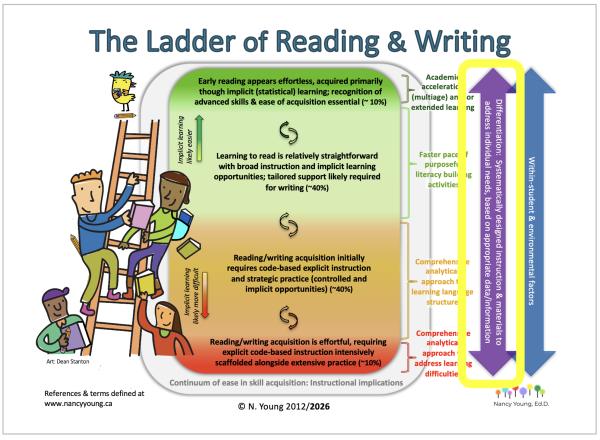
Purple arrow to the right of the continuum
“Differentiation: Systematically designed instruction & materials to address individual needs, based on appropriate data/information”
“Differentiation”
A needs-based approach is central to the message of my Ladder of Reading & Writing. Our students require, and deserve, instruction that aligns to their needs. The purple arrow is pointing up AND down to emphasize that differentiation applies across the continuum. Differentiated instruction and practice opportunities need to be flexible enough to support academic learning needs and offer continued learning in areas of personal strengths and interests wherever possible. Differentiation for reading and writing skill development can be provided in various ways:
- Multiage grouping, collaboratively organized groupings based on skill (not age), groups consisting of students from two or more grades
- Same-age grouping across a single grade, children of the same age learning new skills with peers of similar ability, teachers of the same grade collaborating to form skill-based groups
- Grouping of students within a single classroom, one classroom teacher being responsible for teaching (or arranging with supporting adults to help teach) groups with varying needs in appropriate ways
Note that no matter how skill-based grouping is arranged, there will still be differentiation happening within those arranged groups. For example, if a school organizes multiage grouping there will still be differentiation within each of those larger multiage groups.
“Systematically designed instruction & materials to address individual needs,” Wherever an individual student is on the continuum of ease in learning to read, systematic design ensures appropriate instruction and materials. Systematically designed instruction encompasses (Gillis & Young, 2024):
- Defined goals
- Specific skills or concepts or strategies taught
- Logical sequence
- Examples
- Distributed practice
In applying the above aspects to systematically designed instruction, the result will be variations of instruction and materials based on need. For example, the instructional goals, specific skills taught and examples provided within a systematically designed literacy lesson for a beginning or struggling reader will be different from those for a student who began school already reading. The ability to justify WHO needs WHAT and WHY should be inherent to the planning and implementation of systematically designed instruction and materials.
“Based on appropriate data/information:” Collecting the right data enables educators ask relevant questions regarding the systematic design of needs-based programming and materials.
Screeners are currently being used in many schools to determine who may be at risk for difficulty in learning to read; data from such a screener indicating that a student is behind expectation will usually extend to the provision of diagnostic assessments to obtain more information. (See Hasbrouck, 2024.)
Data can inform educators as to who is advanced (and how far ahead they may be), but the measurement tools will generally be different from those used for a beginning or struggling reader. For example, students who are already reading should not be given a screener to test their phonemic awareness skills. (See Diamond. 2026.)
Obtaining data from standardized achievement tests is an appropriate way to determine programming for students already reading beyond grade-level due to data-gathering that includes no-ceiling tests (Young, 2024). A curriculum-based measure that can be helpful in gauging advanced reading skills in the early primary grades is the Oral Reading Fluency (ORF) measure (Hasbrouck & Tindall, 2006; Hasbrouck & Tindall, 2017; Hasbrouck personal communication 2025).
The word information on the purple arrow recognizes the importance of finding out about a student’s reading and/writing skills and attitudes using means other than tests. This includes teacher observation of the student in the classroom and in other school-based activities. Do they avoid books and demonstrate reluctance to engage in literacy activities? Or, are they engrossed in a book instead of playing on the climbing apparatus during recess? Feedback from caregivers should be gathered not just to find out the child’s attitude and behaviours towards reading and writing in the home setting, but to shed light on possible hereditary factors . Is there a family history of reading difficulties? Is there a family history of early advanced reading abilities?
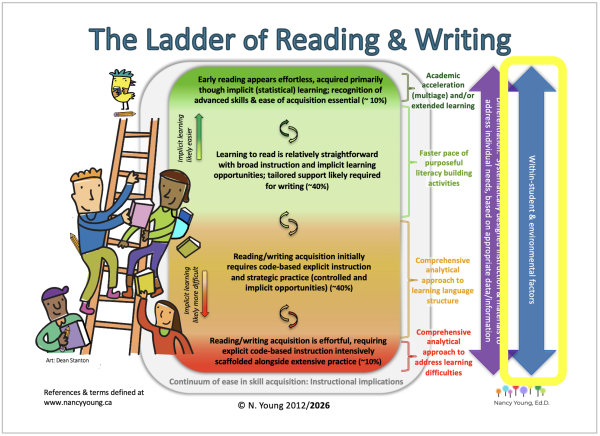
Blue arrow to the right of the continuum
“Within-student & environmental factors” The ease in which children learn to read and write can range due to an interplay of genetic and environmental factors (Boada et al., 2002; Olson et al., 2014; Pennington et al., 2015; Christopher et al., 2015). The blue arrow is pointing up AND down to indicate that we must consider these factors for any student, wherever they seem to be on the coloured continuum.
Within-student factors include:
-
- Attentional disorders
- Psychological disorders (such as anxiety, perfectionism, motivation, traumatic experiences)
- Exceptionalities (e.g., reading disability/dyslexia, specific reading comprehension disability, developmental language disorder, intellectual disability, intellectually gifted/advanced)
NOTE: A child should not be required to have a label to receive instruction that is appropriate for their individual need. The terms above recognize the reality that most states and provinces currently require a specific designation for a student to be entitled to special services.
Environmental factors include:
-
- Teacher/school
- Literacy in the home
- Language/dialect
- Economic circumstances
With regard to environmental circumstances, I caution educators not to lower expectations due to low SES (socio-economic status). Although there is certainly research indicating that children coming to school from impoverished backgrounds may be at greater risk of experiencing difficulties in learning to read and write, please do not assume that all children from low SES backgrounds will automatically need what child with a reading disability is likely to need. A child from a low SES background may arrive with few readiness skills but grasp skills quickly once provided appropriate instruction. A child from a low SES background may arrive at school already knowing how to read!
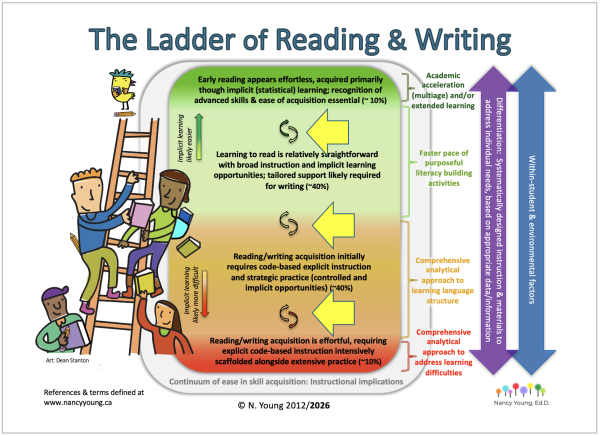
Curved arrows between the areas of the continuum
The curved arrows between the colours in the continuum indicate that students may need more or may need less instruction in certain components. We need to teach based on need, and students may have stronger skills in one component of reading and writing than another.
Awareness of personal strengths and interests is especially important for children who are intellectually above average yet have a reading disability and/or ADHD (often described as being twice exceptional or 2e).
Wrapping Up This Overview
My 2026 update not only continues to translate the research on the instructional implications of the wide range of ease in learning to read, but represents my ongoing efforts to help educators and families and the countless other people referencing my work to better understand, and then implement, appropriate programming. During this time of rapid changes across North America and in many other countries. I believe that equitable education requires that our educators understand there will be wide range of ease in learning to read and write from Day 1 of school. To appropriately support each student no matter where they sit on the continuous distribution, educators must be equipped to consider WHO is learning, WHAT they need, and WHY.
“Educational equity does not mean educational sameness. Equity respects individual differences in readiness to learn and recognizes the value of each student.”
Colangelo et al., 2004, p. 2
Would you like to use The Ladder of Reading & Writing infographic in a presentation or another context?
Please click HERE for usage/permission guidelines and forms.
Acknowledgements
My HUGE THANKS to the following colleagues who generously gave their time as they deliberated over my words and reflected on current issues in the field regarding the provision of literacy instruction, so to provide me with helpful feedback during the 2026 update process:
Once again, I was so fortunate to have as a sounding board Dr. Jan Hasbrouck. Jan was my sounding board for the 2021 and 2023 updates and co-edited with me book Climbing The Ladder of Reading & Writing: Meeting the Needs of ALL Learners (2024).
I greatly appreciated the valuable insights of Dr. Margie Gillis (President of Literacy How Inc.) in 2023 and again for this 2026 update. Margie co-authored with me the chapter “Instructional Implications” (Chapter 3) in the book Climbing The Ladder of Reading & Writing: Meeting the Needs of ALL Learners.
As I wrestled with the words and features within the 2026 update over a four-month period, I was immensely grateful to share my thinking with, and to receive such helpful feedback from, the following knowledgeable and highly respected colleagues with whom I am collaborating in various ways as part of our international AIR Fliers team:
Julie Brehmer, Ph.D. Michigan, USA. Assistant Professor of Teacher Education, Saginaw Valley State University
Dawn Brookhart, M.Ed., M.A.T. Pennsylvania, USA. Instructional leader, consultant. Co-author of Instructional Leadership in Student-Focused Coaching: Creating Effective Systems to Cultivate Student Success (2026)*
Christi Corbin, M.Ed., Washington, USA. Learning specialist for students in grades 3–5
Tessa Daffern, Ph.D., Sydney, Victoria, Australia. Adjunct Associate Professor, SOLAR Lab School of Education, La Trobe University, Australia; author of the Components of Spelling Test (CoST)™ and Components of Spelling Test: Early Years (CoSTEY)™; Co-director & Principal Consultant, Literacy Education Solutions Pty Ltd.
Shannon Heisserer, M.Ed., Missouri, USA. Educational Consultant at Southeast MO State University
Ingrid Hillgrove, B.A. (English Literature & Education), Post Graduate Diploma (Teaching), Post Graduate Diploma (Education Specializing in Literacy), Picton, South Island, New Zealand. Intervention Specialist
Kirsten Kelley, M.Ed., Ed.D. student at Gordon College (Science of Learning). California, USA. K-2 ELA Specialist, IMSE Trainer
Summer Kline, M.Ed. (Curriculum & Instruction), Ohio. First Grade Teacher, Adjunct Instructor at Ohio University,
Principal’s License in progress
Caroline Lacksen, M.Ed. Georgia, USA. Professional Development Specialist, Sandra Dunagan Deal Center for Early Language and Literacy,
Georgia College & State University
Rebecca Miles, M.A., Michigan, USA. Early Literacy Consultant/Coach Coordinator, Berrien RESA / Owner, 3E Reading
Maria Morris, B. Ed. (Child Development), Washington. Reading Interventionist for K-2, Special Education Support Staff
Emma Newton, B.Mus., Diploma of Teaching, Wellington, North Island, New Zealand. Teacher, Intervention Teacher
Briarne Oldham, M.Ed., Christchurch, South Island, New Zealand. Ph.D. student at University of Canterbury, Lecturer in initial teacher education for primary (Years 0-8). Teaching in literacy, inclusive education and behaviour, curriculum, professional practice
Sarah Phillips, M.Ed., C-SLDI. Arizona, USA. Elementary Education Faculty, Teacher Education Department, Pima Community College Desert Vista Campus
Amy Thompson, Ph.D., Arkansas, USA. CALT; C-SLDS; QI-in-Training; Associate Professor UCA; Consultant; Program Director
Jennifer Wright, M.S.Ed. (Reading), M.A.Ed. (Curriculum & Instruction), Missouri, USA. Reading Interventionist, Literacy Consultant,
OG Trainer and Tutor, Admin of MO SoR Facebook group, Reading Advisory Board at NWMSU
References
(Full document listing references supporting the information shared within my Ladder of Reading & Writing, available HERE):
Arciuli, J., & Simpson, I. C. (2012). Statistical learning is related to reading ability in children and adults. Cognitive Science, 36(2), 286-304.
Kidd, E., & Arciuli, J. (2016). Individual differences in statistical learning predict children’s comprehension of syntax. Child Development, 87(1), 184-193.
Colangelo, N., Assouline, S., & Gross, M. (2004). A nation deceived: How schools hold back America’s brightest students. The Connie Belin & Jacqueline N. Blank International Center for Gifted Education and Talent Development.
Boada, R., Willcutt, E. G., & Tunick, R. A., Chabildas, N. A., Olson, R. K., DeFries, J. C., & Pennington, B. F. (2002). A twin study of the etiology of high reading ability. Reading and Writing, 15 (7–8), 683–707.
Clemens, N. & O’Donnell, C. (2024). Specific reading comprehension disability. In N. Young & J. Hasbrouck (Eds.), Climbing The Ladder of Reading & Writing: Meeting the needs of all learners (pp. 106-119). PD Essentials/Benchmark Education.
Christopher, M. E., Hulslander, J., Byrne, B., Samuelsson, S., Keenan, J. M., Pennington, B., … & Olson, R. K. (2015). Genetic and environmental etiologies of the longitudinal relations between prereading skills and reading. Child Development, 86(2), 342-361.
Connor, Carol McDonald (2014). Individualizing teaching in beginning reading. Published in “Better: Evidence-Based Education” by the Institute for Effective Education, University of York, Heslington, York and the Center for Research and Reform in Education at Johns Hopkins School of Education, Baltimore.
Connor, Carol & Morrison, Frederick & Katch, Leslie. (2004). Beyond the reading wars: Exploring the effect of child-instruction interactions on growth in early reading. Scientific Studies of Reading, 8. 305-336.
Dehaene, S. (2011). The massive impact of literacy on the brain and its consequences for education. Human Neuroplasticity and Education. Scripta Varia (117), 19–32.
Elliott, J. G. (2020). It’s time to be scientific about dyslexia. Reading Research Quarterly, 55, S61-S75.
Fletcher, J. M., Lyon, G. R., Fuchs, L. S., & Barnes, M. A. (2019). Learning disabilities: From identification to intervention (2nd ed.), Guilford Press.
Gillis, M. & Young, N. (2024). Instructional implications. In N. Young & J. Hasbrouck (Eds.), Climbing The Ladder of Reading & Writing: Meeting the needs of all learners (pp. 24-45). PD Essentials/Benchmark Education.
Hasbrouck, J. (2024). Data-informed instruction. In N. Young & J. Hasbrouck (Eds.), Climbing The Ladder of Reading & Writing: Meeting the needs of all learners (pp. 46-65). PD Essentials/Benchmark Education.
Hasbrouck, J. (2024). Dyslexia. In N. Young & J. Hasbrouck (Eds.), Climbing The Ladder of Reading & Writing: Meeting the needs of all learners (pp. 94-105). PD Essentials/Benchmark Education.
Hasbrouck, J. (2025). Personal communication.
Hasbrouck, J., & Tindal, G. A. (2006). Oral reading fluency norms: A valuable assessment tool for reading teachers. The reading teacher, 59(7), 636-644.
Hasbrouck, J. & Tindal, G. (2017). An update to compiled ORF norms (Technical Report No. 1702). Eugene, OR, Behavioral Research and Teaching, University of Oregon.
Hoover, W. (2025). Personal communication.
Hoover, W. A., & Tunmer, W. E. (2020). The cognitive foundations of reading and its acquisition: A framework with applications connecting teaching and learning, Springer.
Kligler, N., & Gabay, Y. (2023). A cross-modal investigation of statistical learning in developmental dyslexia. Scientific Studies of Reading, 27(4), 334-354.
National Association for Gifted Children (n.d.). Myths about gifted children, https://www.nagc.org/myths-about-gifted-students
Singh, S., Walk, A. M., & Conway, C. M. (2018). Atypical predictive processing during visual statistical learning in children with developmental dyslexia: an event-related potential study. Annals of Dyslexia, 68(2), 165-179.
Spencer, M., Kaschak, M. P., Jones, J. L., & Lonigan, C. J. (2015). Statistical learning is related to early literacy-related skills. Reading and Writing, 28(4), 467-490.
Olson, R.K., Keenan, J.M., Byrne, B., & Samuelsson, S. (2014). Why do children differ in their development of reading and related skills? Scientific Studies of Reading, 18, 38–54. https://pmc.ncbi.nlm.nih.gov/articles/PMC4120985/pdf/nihms-483349.pdf
Peterson, R. L., & Pennington, B. F. (2015). Developmental dyslexia. Annual Review of Clinical Psychology, 11(1), 283-307.
Rimm, S., Siegle, D., & Davis, G. (2018). Education of the gifted and talented (7th ed.). Pearson Education.
Seidenberg, M. (2023). Is the science of reading becoming too much of a good thing? https://www.edweek.org/teaching-learning/opinion-is-the-science-of-reading-becoming-too-much-of-a-good-thing/2023/12
Seidenberg M. (n.d.). https://www.seidenbergreading.net/blog
Seidenberg, M. (2026). That New Yorker article. Blog post retrieved from: https://www.seidenbergreading.net/blog/oexqqvuvpmotni4qb9f30dvrfbwj05
Seidenberg, M. S., & MacDonald, M. C. (2018). The impact of language experience on language and reading: A statistical learning approach. Topics in Language Disorders, 38(1), 66-83.
Share, D. (1995) Phonological recoding and self-teaching: sine qua non of reading acquisition. Cognition 55, 151-218.
Slade,. M. (2022). Language development and education of advanced learners and precocious readers. In The Development of the High Ability Child: Psychological Perspectives on Giftedness. Miller, E., Matthews, M., & Dixon, D. (Eds.) (pp. 77-109). Routledge.
Stewart, J., Conner, C., & Al Otaiba (2024). Dyslexia. In N. Young & J. Hasbrouck (Eds.), Climbing The Ladder of Reading & Writing: Meeting the needs of all learners (pp. 158-171). PD Essentials/Benchmark Education.
Templeton, S. & Morris, D. (2000). Spelling. In M.L. Kamil, P.B. Mosenthal, P.D. Pearson, & R. Barr. (Eds.). Handbook of Reading Research. (Vol. 3, pp. 525-543). Routledge.
Treiman, R. (2018). Teaching and learning spelling. Child Development Perspectives, 12(4), 235-239.
Treiman, R., & Kessler, B. (2006). Spelling as statistical learning: Using consonantal context to spell vowels. Journal of Educational Psychology, 98(3), 642.
Treiman, R., & Kessler, B. (2022). Statistical learning in word reading and spelling across languages and writing systems. Scientific Studies of Reading, 26(2), 139–149.
VanTassel-Baska, J. (2026). Acceleration is still the lodestone for gifted program development. Gifted Child Today, 49(2), 160-165.