
Nancy Young, Ed.D.
Reading | Writing | Learning
ACADEMICALLY ADVANCED/COGNITIVELY ADVANCED/Gifted Resources
Nancy Young, Ed.D.
Reading | Writing | Learning
The 2024 book
co-edited by Nancy Young and Jan Hasbrouck
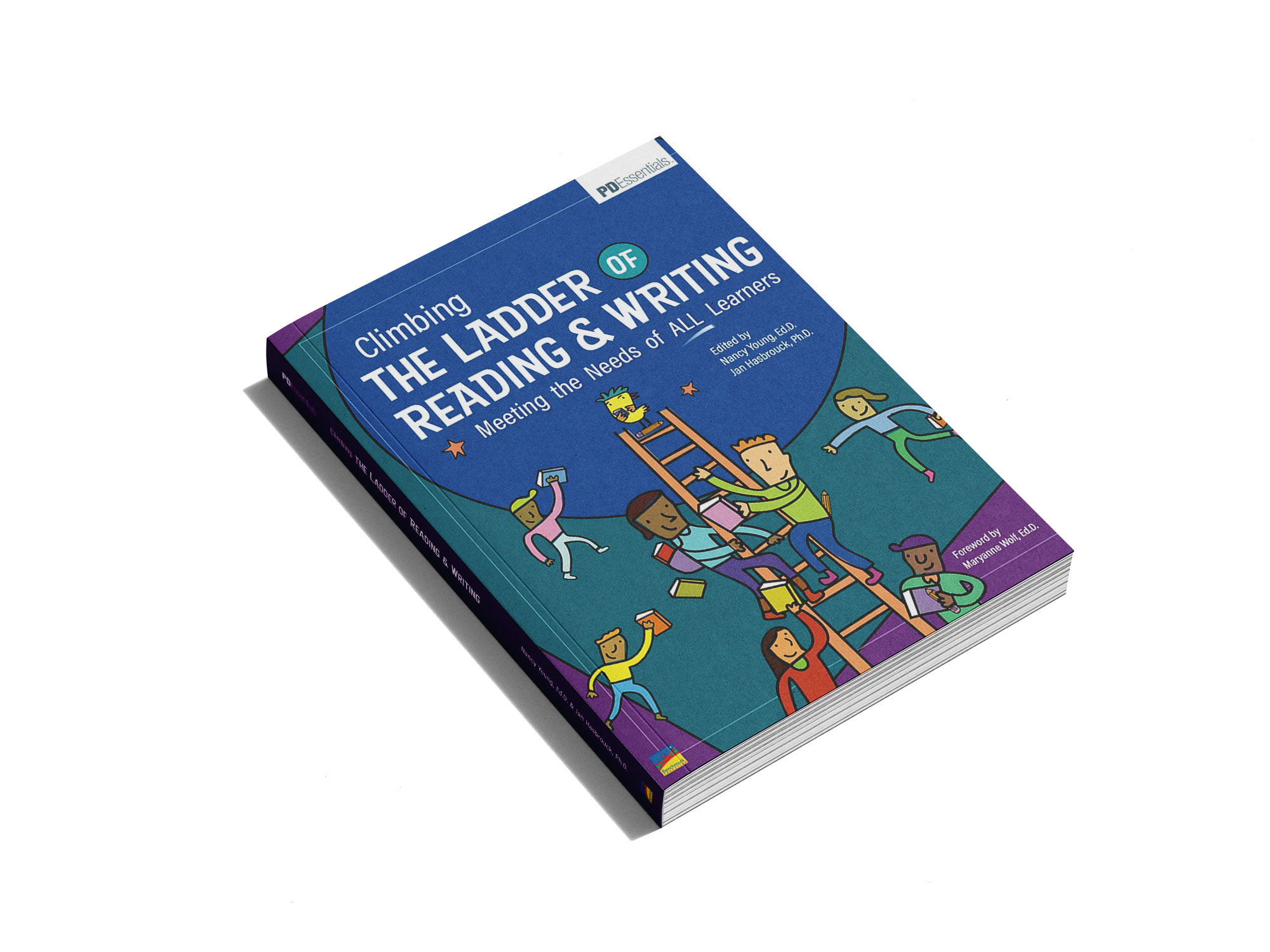
Instruction for advanced/gifted children is addressed in Climbing THE LADDER OF READING & WRITING: Meeting the Needs of ALL Learners
Ch. 13: Advanced in Reading (AIR) (Nancy Young)
Additional Book Recommendations
Education of the Gifted and Talented (7th ed.).
Rimm, S., Siegle, D. & Davis, G. (2018).
Failing Our Brightest Kids: The Global Challenge of Educating High-Ability Students.
Cambridge, MA: Finn, Chester & Wright, Brandon (2015). Harvard Education Press.
Gifted Education: A Survey of Current Research on Giftedness and Talent Development.
Plucker, J. & Callahan, C. (2020).
The Development of the High Ability Child: Psychological Perspectives on Giftedness.
Miller, E., Matthews, M., & Dixon, D. (2022).
Articles / reports
General Overview
Addressing excellence gaps in K-12 education.
Building a wider, more diverse pipeline of advanced learners: Final report of the National Working Group on Advanced Education.
The broken pipeline: Advanced education policies at the local level.
Key themes and recommendations from The Dream Unencumbered: NAGC invitational colloquium.
Identification/Assessment
The Gated Path: Are We “Testing to the Floor” and Harming our Smartest Readers?
The role of assessments in the identification of gifted students.
Effect of local norms on racial and ethnic representation in gifted education.
Rethinking how we identify ‘gifted’ students.
Programming for Advanced Students
General:
What works: 25 Years of commitment to gifted children through research and curriculum at the Center for Gifted Education at The College of William and Mary
Curriculum as motivation for gifted students. Psychology in the Schools.
Top 20 principles from psychology for preK–12 creative, talented, and gifted students’ teaching and learning.
Why not let high ability students start school in January? The curriculum compacting study.
Academic Acceleration:
Acceleration (NAGC Position Statement 2025)
A nation deceived: How schools hold back America’s brightest students.
A nation empowered: Evidence trumps the excuses holding back America’s brightest students.
Talking with a student about academic acceleration.
Acceleration: Tips for Receiving Teachers
What do Parents Need to Know About Academic Acceleration?
Differentiation:
Differentiating curriculum and instruction for gifted and talented students.
Equity and Programming
THINK AGAIN | Are Education Programs for High-achievers Inherently Inequitable?
Addressing Excellence Gaps in K-12 Education
Excellence gaps by race and socioeconomic status.
Ohio’s lost Einsteins: The inequitable outcomes of early high achievers.
Addressing excellence gaps: Frontloading.
Teacher Training
Universal Educator Preparation in Gifted Education 2024.
Faculty standards for teacher preparation programs in gifted & talented education.
High-achieving students in the era of NCLB.
Young Gifted Children
Early childhood: Creating contexts for individualized learning in early childhood education.
Parenting with eyes wide open: Young gifted children, early entry and social isolation.
Some Specific Programs/Materials Related to Early Advanced in Reading (AIR)
Schoolwide Enrichment Model-Reading
William & Mary Language Arts Materials
Dr. Tessa Daffern’s Spelling Assessments and Classroom Materials
NOTE: These materials (extending into study of morphology) are based on Dr. Daffern’s extensive research and the research of renowned researchers (i.e. Virginia Berninger). These resources also offer word study opportunities that may be helpful in supporting differentiated spelling instruction for AIR students who are in classrooms in which teachers are required by their school or district to strictly follow a phonics scope & sequence (meaning students who can already read AIR are confined to a sequence designed for beginning or struggling readers).
General Gifted Programming Standards (United States)
National Standards
Pre-k-grade 12 gifted programming standards.
Applying the pre-k-grade 12 gifted programming standards: Guiding questions.
Common core and next generation science standards for gifted and talented students.
State of the States
State of the states in gifted education.
High stakes for high schoolers: State accountability in the age of ESSA.
Gifted Education Program Standards: Individual State Example
North Carolina academically or intellectually gifted program standards.
Websites
Acceleration Institute at the Belin-Blank Center
Gifted Education Resource Institute, Purdue University
Gifted Education Services for Educators and Schools Northwestern
Massachusetts Association for Gifted Education (MAGE)
National Association for Gifted Children
National Resource Center on Advanced Education (NRCAE)
Programs for Talented Youth, Vanderbilt University
Texas Association for the Gifted and Talented
The Ohio Association for Gifted Children
World Council for Gifted and Talented Children